Patching a single server is relatively straightforward. Maintaining the patch state of an entire infrastructure fleet is a different operational problem.
As an environment grows, manually connecting to individual servers, checking updates and applying patches becomes increasingly difficult to control and repeat consistently.
The engineering perspective
Patching is not simply about installing updates. It is about maintaining a known, controlled and recoverable state across infrastructure.
01
The operational problem
A small environment may be manageable through manual administration. As the number of instances increases, the same approach introduces operational risk.
Manual SSH operations
Engineers connect to individual machines and perform repetitive maintenance tasks.
Inconsistent patch levels
Different servers can end up running different patch states.
Limited visibility
It becomes harder to determine which instances are compliant.
Operational risk
Updating production systems without a controlled process can introduce unnecessary disruption.
02
What AWS Systems Manager provides
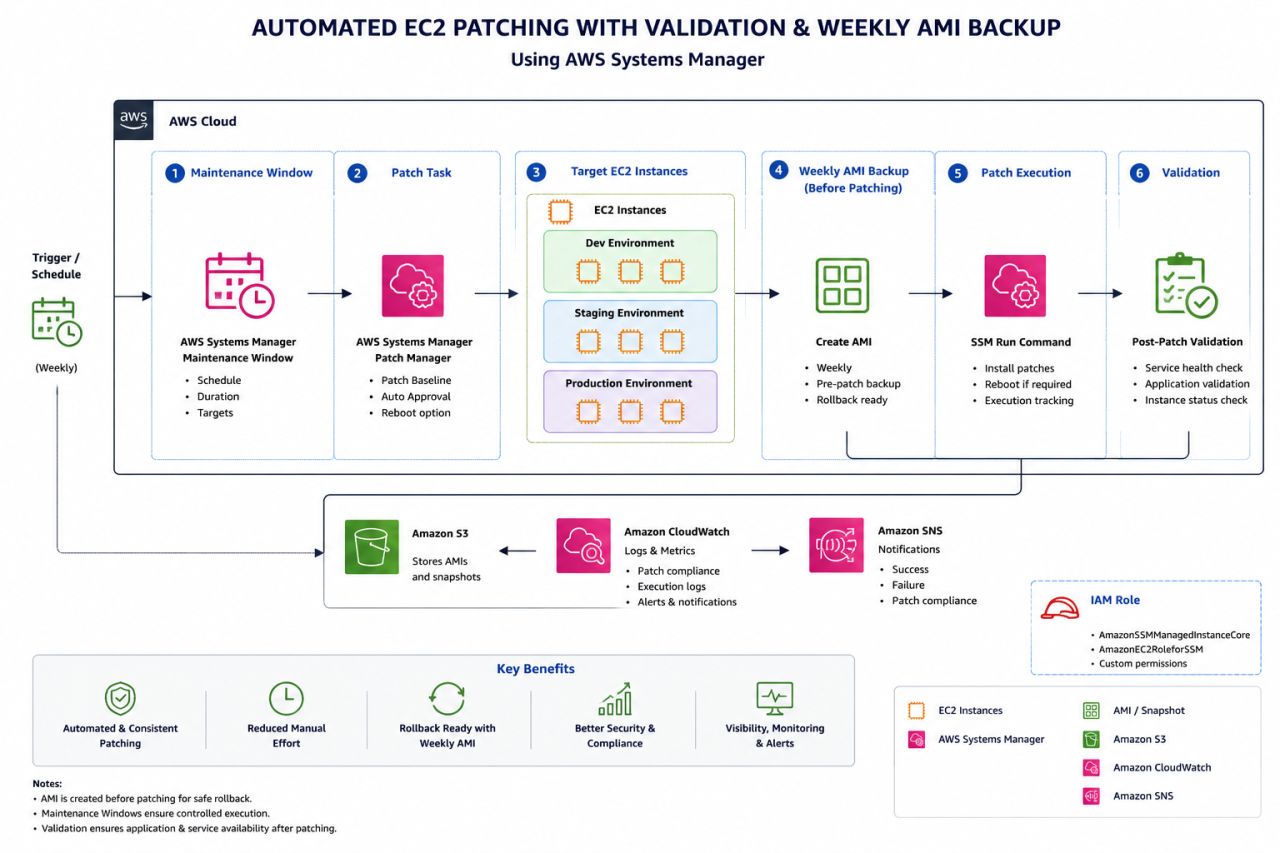
AWS Systems Manager provides centralized capabilities for managing EC2 instances and other managed nodes without requiring an engineer to manually perform the same operation on every server.
Patch Manager
Evaluate and install approved operating-system patches.
Maintenance Windows
Define controlled periods for infrastructure maintenance.
Run Command
Execute operational commands across targeted managed nodes.
03
Making EC2 instances manageable
Centralized management starts before the patch operation itself. The EC2 instances need to be available as managed nodes.
This highlights an important infrastructure principle: automation depends on both identity and management connectivity.
04
Patch baselines
A patching system should not be treated as a mechanism for blindly installing every available update.
A patch baseline defines the rules used to determine which patches should be considered approved or required for a particular environment.
The operational question is not simply "Can we install patches?" It is "What patch state does our organization consider acceptable?"
05
Targeting the right instances
Infrastructure automation becomes easier to operate when instances can be grouped logically rather than selected manually by instance ID.
Environment = Production
Application = Payments
PatchGroup = Production
Tags can then be used as a targeting mechanism for maintenance operations.
06
Scheduling patch operations
Production maintenance should not depend on someone remembering to log in and run a command manually.
A maintenance window provides a controlled period during which infrastructure maintenance activities can be executed.
07
A production patching strategy
The safest patching process is not necessarily the one that updates every server at the same time.
Environments can be patched in controlled stages, allowing problems to be identified before changes reach the most critical workloads.
Automation should reduce operational effort without removing operational control.
08
Post-patch validation
A successful patch command does not automatically mean that the workload is healthy.
Instance health is verified
Required services are running
Application health checks succeed
Monitoring remains operational
Production traffic remains healthy
The operational workflow therefore becomes:
Patch
  ↓
Validate instance
  ↓
Validate services
  ↓
Validate application
  ↓
Validate monitoring
  ↓
Confirm workload health
09
Compliance and visibility
Centralized patching becomes significantly more useful when administrators can determine the patch state of the fleet rather than simply executing update commands.
Compliant
Instance meets the defined patch requirements.
Missing patches
Required updates still need attention.
Needs attention
Operational investigation may be required.
10
Security and IAM
Centralized automation does not remove the need for least privilege. In fact, the permissions used by automation become even more important because they can affect multiple systems.
- Instance identity: provide the permissions required for Systems Manager operations.
- Maintenance permissions: use appropriate roles for scheduled operational tasks.
- Least privilege: avoid granting broader permissions than the workflow needs.
11
Production checklist
Management
Patch policy
Operations
Validation
Recovery
Engineering perspective
Patching is an operational capability
The objective of centralized patching is not simply to make updates faster. The objective is to create a repeatable process that keeps infrastructure in a known state while reducing unnecessary manual intervention.
Good infrastructure automation does not eliminate operational discipline. It makes that discipline repeatable.